

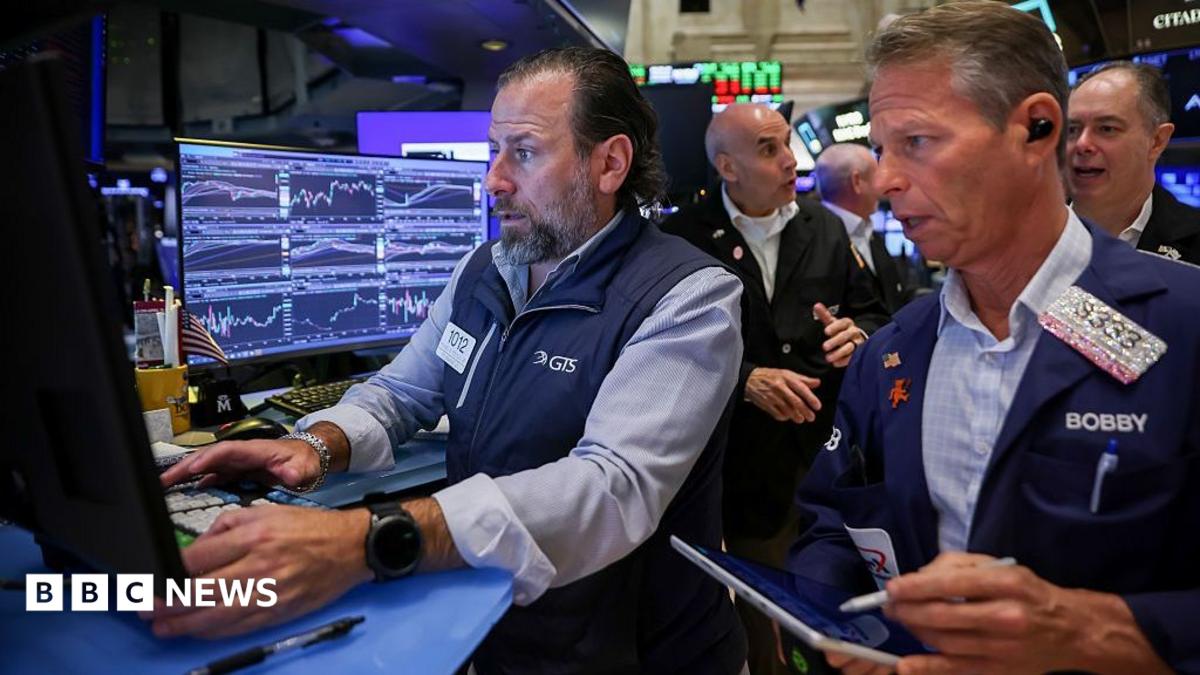
Global Tech Sell-Off Follows US Midterm Results
A massive erosion of shareholder value struck technology companies in both the United States and Asia this week, as the outcome of the US midterm elections amplified existing anxieties about a potential deceleration in artificial intelligence development. The sell-off erased hundreds of billions of dollars in combined market capitalisation across major tech and AI-related firms on both sides of the Pacific.
The tech-dominated Nasdaq Composite Index shed more than 5.5% in a single session, representing an estimated $2.5 trillion (£1.9 trillion) in lost market value according to Dow Jones data. Other major US benchmarks also posted their steepest single-day declines since 2025. The S&P 500 dropped 4.4% by the close, while the Dow Jones Industrial Average gave back all of its Wednesday gains to finish more than 3.4% lower. The Nasdaq's cumulative decline pushed the index into what analysts classify as correction territory, meaning it now sits at least 10% below its most recent peak.
The pressure on stocks came amid a broader, pre-existing debate over whether the enormous capital being poured into AI infrastructure will ultimately generate the returns investors have been pricing in. The midterm result simply added a new, political dimension to that concern.
Asian Chipmakers Bear the Brunt of the Panic
The contagion spread quickly to Asian markets on Friday morning. Japan's Nikkei 225 was trading 6% lower in early sessions, dragged down by a sharp decline in memory-chip maker Kioxia, whose shares fell over 12.6%, and equipment supplier Tokyo Electron, which slipped 9.5%.
South Korea's semiconductor sector was hit even harder. SK Hynix lost more than 11.5% of its value, while Samsung Electronics dropped nearly 10%. The combined rout in Seoul pushed the Kospi index down more than 8.5%, a move severe enough to trigger a circuit breaker — a trading-halt mechanism designed to interrupt panic selling and give market participants time to reassess.
Political Shifts Put AI Data-Centre Plans in Question
The driver behind the sell-off was the Democratic sweep of both the US Senate and the House of Representatives in Tuesday's midterms, giving the party control of Congress for the remainder of President Donald Trump's term. Democrats across the country had run campaigns explicitly centred on slowing the rapid expansion of data centres and AI infrastructure. Dozens of ballot measures in various states sought to impose restrictions on the construction of the computing hubs essential to powering large language models and other AI workloads.
In Texas, Democratic governor-elect Gina Hinojosa made opposition to data-centre construction a central pillar of her campaign, vowing a moratorium on new builds in the sector once she took office. This was a particularly significant signal given Texas's role as a major site for new AI infrastructure.
President Trump took to social media to assign blame for the market turbulence. "The Stock Market suffered one of the Worst Days in History based on the results of the Election," he wrote. "Remember, it wasn't Republicans, it was Dumocrats. Do not fear, however, we will soon, one way or the other, be BIGGER AND STRONGER THAN EVER BEFORE. MAKE AMERICA GREAT AGAIN!"
On the other side of the aisle, Senator Bernie Sanders framed the issue in terms of public accountability. "Americans don't want Big Tech oligarchs wrecking the environment, gutting jobs and threatening humanity's future. NATIONAL DATA CENTER MORATORIUM NOW," the Vermont Democrat posted on X on Thursday, signalling that his party intends to use its new congressional majority to push for tighter oversight of the sector.
Individual Tech Names and the Magnificent Seven Take Heavy Hits
The damage was concentrated among companies most directly tied to AI hardware and data-centre buildout. Nvidia, the leading designer of AI accelerators, saw its shares slide more than 9%, wiping out over $400 billion in market value. AMD and Micron Technology each fell by more than 17%, Intel dropped 10.3%, and memory-card maker SanDisk plunged over 22%. The Philadelphia Semiconductor Index, which tracks 30 of the largest firms in chip manufacturing, lost more than 12% in the session.
Elon Musk's publicly traded interests were not spared. Tesla shares fell nearly 11%, while SpaceX — though private — saw its valuation drop roughly 8%. Together, the losses at the two firms exceeded $300 billion in a single day. The setback was a stinging blow for Musk, who had committed close to $450 million to Republican election efforts, including at least $45 million in support of Ken Paxton's unsuccessful bid for the Texas Senate seat. Despite that outlay, Texas shifted to Democratic control on election night.
In aggregate, the so-called Magnificent Seven — the group of mega-cap tech names including Apple, Nvidia, and Tesla — lost a combined one trillion dollars in market value in a single trading session, one of the largest one-day write-downs on record for that cohort.
Industry Leaders React; Analysts Warn of Broader Corrections
Several prominent figures in the AI industry acknowledged that the political backlash against data centres had caught them off guard. Greg Brockman, co-founder and president of OpenAI, told the Wall Street Journal Tech Conference in Napa, California, on Wednesday evening that the industry had underestimated how strongly local communities would resist new infrastructure. "A lot of our shift over the course of this year has really been to realise that from San Francisco trying to build infrastructure in Texas, Georgia, and other places, you can't just tweet and say: 'This is going to be good.' You need to be in those communities," he said, conceding that more work was needed to build public support.
Dina Powell McCormick, president of Meta, echoed the sentiment at the same conference, arguing that the sector needs to invest far more in public communication. "I think we need to double and triple down on telling the story," she said, referring to the case for AI as a net positive for society.
Susannah Streeter, chief investment strategist at Wealth Club, warned that the sharp declines on the Nasdaq and S&P 500 would ripple through other asset classes. "Fresh panic over the AI trade has hit Wall Street hard," she told BBC Business. "Fears that the vast sums poured into AI infrastructure may not deliver the returns investors have been banking on are now colliding with the prospect of a sharp slowdown in data centre construction."
Beyond the immediate political shock, a growing chorus of market participants has begun to question whether AI-related equities have entered bubble territory primed for a broader correction. The convergence of political risk, community opposition, and valuation concerns has left traders on high alert, with many watching for signs that the sell-off could extend well beyond the semiconductor and data-centre clusters that led this week's rout.