
Broad Market Decline Driven by Inflation Fears and AI Jitters
Major U.S. equity indexes ended Tuesday's session in the red, with the S&P 500 shedding 0.45%, the Dow Jones Industrial Average dropping 0.63%, and the Nasdaq 100 falling 0.65%. E-mini S&P 500 futures slipped 0.44%, while September E-mini Nasdaq futures declined 0.61%. Both the S&P 500 and the Dow slipped to six-week lows, reflecting a broad-based risk-off tone across the session.
Two forces dominated investor sentiment. First, a more than 4% jump in crude oil prices stoked inflation concerns and sent bond yields soaring across the globe. Second, enthusiasm for the artificial-intelligence trade — the single biggest engine of equity gains earlier this year — has cooled as ongoing debate over the technology's potential to cause serious harm and growing political pressure for new regulations cloud the outlook. Adding to the pressure, cryptocurrency-exposed equities fell sharply after Bitcoin dropped more than 4% on news that the Senate blocked a digital-asset market-structure bill in a procedural vote.
On the data front, the September Empire State manufacturing survey for general business conditions plunged 13.0 points to 7.6, well below the 15.0 that economists had forecast, reinforcing concerns about the health of the manufacturing sector.
Oil Supply Disruptions and Global Bond-Yield Surge
October WTI crude (CLV26) jumped more than 4% on Tuesday to print a fresh 3.75-month high. The rally was fueled by persisting disruptions to Middle East supply. On the previous Friday, Saudi Arabia shut down its East-West pipeline — a critical artery carrying 7 million barrels per day — after threats from Houthi rebels. The pipeline routes crude away from the Persian Gulf toward the Red Sea for tanker loading, effectively bypassing the Strait of Hormuz. Saudi officials provided no timeline for reopening the line. Compounding the supply squeeze, Riyadh informed OPEC on the prior Thursday that August crude output had fallen to 6.238 million bpd, the lowest level since 1990.
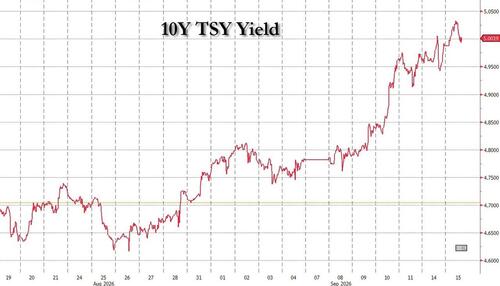
The oil spike rippled through the bond market. The 10-year U.S. Treasury yield climbed to a 19-year high of 5.04%, the 10-year German Bund yield touched a 17-year peak of 3.57%, and the 10-year Japanese government bond yield hit a 30-year high of 3.04%. December 10-year T-note futures (ZNZ6) lost 7.5 ticks, and the cash 10-year yield added 1.0 basis point to 4.998%, with intraday marks reaching 5.039%. T-note futures posted a new 2.75-year low.
Demand for U.S. government debt also softened. The Treasury's $13 billion auction of 20-year bonds drew a bid-to-cover ratio of 2.57, below the 10-auction average of 2.62, leaving prices vulnerable to further downside.
In Europe, the 10-year German Bund yield finished 2.0 bp higher at 3.538% after intraday touching 3.573%, while the 10-year UK gilt rose 2.1 bp to 5.388%. Germany's September ZEW economic-expectations index edged up 0.5 points to 34.7, a seven-month high, though it still trailed the 40.0 consensus.
Rate expectations tightened further: markets priced in a 96% probability of a 25-basis-point Fed hike at the upcoming Tuesday/Wednesday FOMC meeting, and a 56% chance of a 25-bp ECB increase at the October 29 session.
Sector and Individual Stock Movers
Crypto and digital-asset names bore the heaviest losses. Circle Internet Group (CRCL) slid more than 11% and Coinbase Global (COIN) fell over 10%, topping the S&P 500's decliners. Galaxy Digital (GLXY) dropped more than 8%, Riot Platforms (RIOT) shed over 6%, Strategy (MSTR) lost more than 5%, Iren Ltd (IREN) fell over 4%, and MARA Holdings (MARA) along with Robinhood Markets (HOOD) each declined by more than 3%.
Software equities gave back some of Monday's gains. Oracle (ORCL) and Thomson Reuters (TRI) closed down more than 3%; Intuit (INTU) and Adobe Systems (ADBE) dropped over 2%; Atlassian (TEAM), Microsoft (MSFT), Salesforce (CRM), ServiceNow (NOW), and Workday (WDAY) all finished lower by more than 1%.
Airlines and cruise operators fell as the oil spike raised fuel-cost concerns. American Airlines (AAL), Royal Caribbean (RCL), and Norwegian Cruise Line (NCLH) each lost more than 2%. United Airlines (UAL), Alaska Air (ALK), Delta Air Lines (DAL), and Carnival (CCL) slipped by more than 1%.
Semiconductor and AI-infrastructure stocks provided a stabilizing counterweight. The iShares Semiconductor ETF (SOXX) finished up 0.40%. Qualcomm (QCOM) led Nasdaq 100 gainers with a rise of more than 4%. AMD and ON Semiconductor (ON) each added over 2%, while ARM Holdings (ARM), Marvell Technology (MRVL), and ASML Holding (ASML) gained more than 1%. NXP Semiconductors (NXPI) rose 0.95%.
Energy producers and refiners rallied in tandem with the oil spike. APA Corp (APA) jumped more than 5%; ConocoPhillips (COP), Devon Energy (DVN), Phillips 66 (PSX), and Valero Energy (VLO) each rose over 3%; Diamondback Energy (FANG), Marathon Petroleum (MPC), Occidental Petroleum (OXY), and ExxonMobil (XOM) gained more than 2%. Chevron (CVX) climbed over 2% to top Dow gainers.
Notable single-stock moves included Enova International (ENVA), which plunged more than 23% after withdrawing its application with the OCC and the Federal Reserve to acquire Grasshopper Bancorp. Dave & Buster's (PLAY) fell 18% on Q2 revenue of $544.1 million, below the $558.1 million consensus. Axon Enterprise (AXON) dropped more than 9% after announcing plans to issue $1 billion of convertible senior notes due 2031 in a public offering. On the upside, Revvity (RVTY) rose over 9% after executives told attendees at the Baird Global Healthcare Conference that demand for its new high-end platform has "really taken off." Forgent Power Solutions (FPS) gained more than 9% on Q4 revenue of $461.7 million, well above the $432 million estimate. Waystar Holding (WAY) advanced more than 7% following a Reuters report that the company is exploring strategic options, including a potential sale.
Overseas Markets and China Data
International equities also closed lower. The Euro Stoxx 50 slipped 0.38% to a 2.25-month low, China's Shanghai Composite fell 0.54%, and Japan's Nikkei-225 edged down 0.01%.
A cluster of weak Chinese economic indicators added to the bearish backdrop. August retail sales grew just 0.4% year-over-year, missing the 0.8% forecast. The surveyed unemployment rate ticked up 0.1 point to 5.3%, versus an expected 5.2%. New-home prices declined 0.17% month-over-month, marking the 39th straight monthly drop. On a brighter note, August industrial production rose 5.2% year-over-year, outpacing the 4.8% consensus.
Looking ahead, Aeluma Inc (ALMU) and Lennar Corp (LEN) were slated to report earnings on September 16, 2026.