
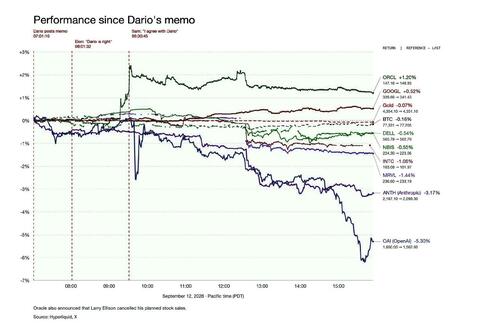
Broader Market Closes Lower Amid AI and Inflation Headwinds
U.S. stock markets ended the session in negative territory on Monday, September 14, 2026, with the S&P 500 shedding 0.48%, the Dow Jones Industrial Average slipping 0.29%, and the Nasdaq 100 dropping 0.82% to a six-week low. E-mini S&P 500 futures (ESU26) were off 0.46%, while September E-mini Nasdaq futures (NQU26) declined 0.77%.
The primary catalyst for the sell-off was a coordinated signal from the heads of leading artificial-intelligence companies calling for a deliberate slowdown in the development of the most advanced AI models. That warning struck at the heart of the capital-expenditure cycle underpinning the semiconductor and AI-infrastructure complex, prompting investors to reassess the sustainability of the multi-billion-dollar buildout narrative. At the same time, a spike in crude oil to a 3.75-month high stoked inflation fears and pushed global bond yields higher earlier in the day, compounding the equity pressure.
AI Restraint Calls Reshape Sector Rotation
The semiconductor sector bore the brunt of the selling. The iShares Semiconductor ETF (SOXX) lost more than 5%, tagging a one-week low. Among individual names, Teradyne (TER) fell over 13% to top the Nasdaq 100 decliners, while Arm Holdings (ARM) dropped more than 9%. Lam Research (LRCX) slid over 8%, ASML Holding (ASML) fell more than 7%, and Marvell Technology (MRVL), KLA Corp (KLAC), and Applied Materials (AMAT) each lost more than 6%. Intel (INTC), NXP Semiconductors (NXPI), and Micron Technology (MU) declined more than 5%, while Advanced Micro Devices (AMD), Analog Devices (ADI), Broadcom (AVGO), SanDisk (SNDK), and Western Digital (WDC) dropped more than 4%. Nvidia (NVDA) and Microchip Technology (MCHP) were each off more than 3%.
The trigger came from Anthropic CEO Dario Amodei, who announced that his company would implement new safeguards and urged the broader industry to temper the pace at which its most capable models are advanced. OpenAI chief Sam Altman and xAI founder Elon Musk publicly endorsed the proposal. For stock investors, the implication is direct: if the top AI labs signal a deliberate deceleration, the near-term demand outlook for cutting-edge chips and data-center infrastructure could soften, compressing valuations that had been built on aggressive growth assumptions.
In a notable sector rotation, software equities moved in the opposite direction. The logic is that a slower AI buildout reduces the pace at which generative tools could displace traditional software business models. Thomson Reuters (TRI) surged more than 8%, while Autodesk (ADSK), Atlassian (TEAM), and ServiceNow (NOW) each gained over 7%. Adobe Systems (ADBE) and Intuit (INTU) rose more than 5%, Datadog (DDOG) and Workday (WDAY) climbed over 4%, and Salesforce (CRM) advanced more than 4% to lead Dow gainers.
Cybersecurity names posted some of the day's strongest moves, with Zscaler (ZS) jumping over 16% and SentinelOne (S) gaining more than 14%. Palo Alto Networks (PANW) and CrowdStrike Holdings (CRWD) each rose over 13%, with CrowdStrike topping both the S&P 500 and Nasdaq 100 gainers. Okta (OKTA) added more than 12%, Fortinet (FTNT) gained over 9%, and Cloudflare (NET) climbed more than 7%.
On the financial front, bank stocks pulled back. Bank of America (BAC) fell 4% after CEO Brian Moynihan characterized third-quarter sales and trading revenue as "relatively flat" year over year. Goldman Sachs (GS) and Morgan Stanley (MS) each dropped more than 3%, while Citigroup (C), JPMorgan Chase (JPM), Bank of New York Mellon (BNY), and Wells Fargo (WFC) all closed down more than 1%.
Other notable movers included Corning (GLW), which lost more than 13% to lead S&P 500 decliners following the announcement of a $2 billion equity distribution agreement with Goldman Sachs. Hewlett Packard Enterprise (HPE) fell over 10% after Evercore ISI downgraded the shares from outperform to inline, citing valuation concerns. Definium Therapeutics (DFTX) gained more than 3% after disclosing that a late-stage trial of its investigational pill for generalized anxiety disorder met both its primary and key secondary efficacy endpoints.
Oil, Inflation, and the Rates Complex
Crude oil was a significant macro variable in Monday's session. October WTI crude (CLV26) rose more than 1% to a 3.75-month high on supply concerns after Saudi Arabia shut down its East-West pipeline late last week as a precaution following Houthi rebel attacks. The pipeline carries 7 million barrels per day and routes crude away from the Persian Gulf toward the Red Sea for tanker loading. Saudi Arabia informed OPEC last Thursday that its August crude output had fallen to 6.238 million barrels per day, the lowest level since 1990.
However, the oil rally lost momentum in the late session after President Trump stated that Ukraine and Russia had agreed to refrain from striking each other's energy infrastructure. U.S. Energy Secretary Chris Wright also tempered supply worries by noting that 12 million barrels of crude transited the Strait of Hormuz on Sunday.
The oil-driven inflation impulse had earlier lifted sovereign bond yields to multi-year peaks. The 10-year UK gilt yield hit a 19-year high of 5.43% before settling 2.4 basis points higher at 5.367%. The 10-year German Bund climbed to a 17-year high of 3.555% and closed 1.3 basis points higher at 3.518%. The 10-year U.S. Treasury note yield touched a 2.75-year high of 5.012% before easing 0.8 basis points to 4.959%; December 10-year T-note futures (ZNZ6) closed up two ticks as short covering and safe-haven buying from the equity sell-off provided support.
Monetary-policy expectations remain hawkish. Markets are pricing in a 92% probability of a 25-basis-point Federal Reserve rate hike at the Tuesday/Wednesday FOMC meeting. In Europe, the odds of a 25-basis-point ECB increase at the October 29 meeting stand at 69%. ECB Executive Board member Isabel Schnabel described recent energy-price developments as "quite concerning" as policymakers weigh further tightening, while Governing Council member Peter Kazimir stated that inflation risks are "clearly tilted to the upside" and signaled the ECB will raise rates further if warranted.
Overseas Markets and Ahead
International equities mirrored the U.S. weakness. The Euro Stoxx 50 slid 1.02% to a six-week low, Japan's Nikkei 225 fell 0.81% to a comparable six-week trough, and China's Shanghai Composite edged down 0.07%.
On the earnings calendar for September 15, 2026, investors will receive results from Critical Metals Corp (CRML), Evolution Petroleum Corp (EPM), and Forgent Power Solutions Inc (FPS).