
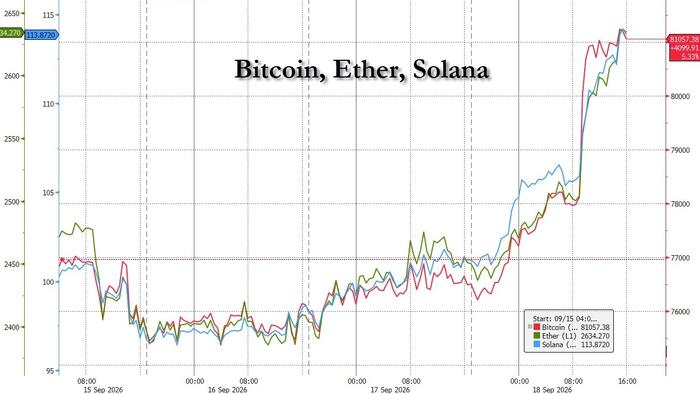
Market Rally Follows SEC's Tokenized Equity Exemption
After a bruising Tuesday saw digital assets slide when the CLARITY Act stalled in the Senate, the crypto market reversed sharply to end the week on a high. The catalyst: the Securities and Exchange Commission released an "Innovation Exemption" order that effectively green-lights the onchain trading of tokenized stocks in the United States.
The move pushed Bitcoin above the $81,000 threshold, but the sharpest movers were the tokens most directly tied to tokenization infrastructure. Solana, a long-standing favorite for onchain equity products, jumped more than 12 percent past $113, while the NEAR Protocol surged roughly 32 percent. Other DeFi and layer-one names followed: Starknet climbed 27 percent, Arbitrum added 26 percent, and Uniswap gained 20 percent.
Looking at the broader top-15 table, Hyperliquid rose 12 percent to $92.20, Solana (on a separate count) added 9.6 percent to $110, Dogecoin climbed 7.7 percent to $0.088, XRP rose 7.6 percent to $1.40, Monero ticked up 6.1 percent to $540, and BNB gained 4.7 percent to $759. Cardano posted a 9.3 percent gain and Chainlink was up 8 percent. Bitcoin itself closed at $81,100, up 6 percent on the day and 2.3 percent over the trailing seven-day window. Ether sat at $2,683, also up 6 percent.
Notably, the price reaction was not immediate. It took nearly a full trading day for the broader market to fully absorb and respond to the SEC's announcement.
Inside the Exemption: What the Order Permits and Restricts
The SEC's Release No. 34-106402, issued on September 17, grants a five-year conditional exemption from registration to a newly defined category called a "Tokenized Securities Venue" (TSV). Under the order, a TSV is exempted from the exchange definition in Section 3(a)(1) of the Securities Exchange Act, provided it uses automated market makers (AMMs) rather than central limit order books (CLOBs). Liquidity providers associated with these venues also receive relief from dealer registration.
Key conditions baked into the exemption include:
- A TSV may list up to 75 Tier 1 equity symbols.
- Trading volume is capped at 0.25 percent of each stock's prior-month average daily volume.
- Tokenized shares must carry identical dividend rights, voting rights, and claims on residual assets as the underlying stock.
- The exemption applies only to natively tokenized equities—those where the blockchain serves as the primary, legally binding ledger and the asset is issued directly onchain by the issuer or its agent. Non-native tokenized equities, which function as onchain wrappers around offchain assets and carry derivative-like characteristics, fall outside the order's scope.
- Issuers retain the right to block the tokenization of their own securities by filing an objection before trading commences.
SEC Chairman Paul Atkins described the action in a statement as "a significant step forward, within our statutory authority, to bring America's capital markets into the digital age." He added that the interim measure "must be followed by durable rulemaking to ensure that onchain markets remain a viable pathway."
Analyst Perspectives: Potential and Caveats
Andrew Yang, an analyst at Kaiko, estimated that tokenized equity volume on Uniswap was running at approximately $800 million per day in a note sent to reporters on Friday morning. However, he flagged a practical concern: "The SEC's condition is rights parity with the underlying stock, and it's not obvious how much of that volume would clear it." In other words, a portion of existing onchain equity flow may not satisfy the strict parity requirement embedded in the order.
Goldman Sachs analyst James Yaro, in a research note available to pro subscribers, offered a more granular breakdown. He characterized the order as broadly permitting US tokenized equities for the first time and anticipated that brokerage innovators and crypto-native firms would be the primary builders in this space, leveraging existing tokenized equity products that already operate outside the United States.
Yaro also outlined several structural limitations that could temper adoption speed. Because the exemption is tied to AMMs rather than CLOBs, it is better suited to newer, longer-tail markets. As trade sizes grow, the scarcity-dependent pricing baked into AMM smart contracts introduces greater slippage risk compared with CLOBs, which typically offer deeper liquidity for larger order flow. This dynamic, Yaro noted, could constrain the exemption's impact on high-volume blue-chip names.
The native-versus-non-native distinction also matters. Native tokens represent direct onchain ownership, carry most or all shareholder rights including voting and dividends, and are governed primarily by the issuer's existing regulator. Non-native tokens, by contrast, create a secondary claim on the underlying asset, generally lack full rights, and face dual oversight at both the token and underlying levels. The SEC's order explicitly excludes this latter category.
Broader Regulatory Landscape and What Comes Next
The tokenization order is the latest in a series of regulatory signals. It builds on the SEC's earlier Regulation Crypto Assets framework, which provided issuer-related exemptions. On the same day, September 17, the CFTC issued a no-action position for providers of passive software, exempting developers of permissionless digital asset protocols—such as self-custody crypto wallets—from registration as introducing brokers.
Both the SEC and CFTC chairs have publicly expressed a desire to craft comprehensive digital-asset regulatory regimes, independent of congressional action. Yet Goldman Sachs cautioned that agency-level rulemaking, while welcome, lacks the permanence of legislation. A future administration could reverse or amend these exemptions through subsequent rulemaking. The firm argued that unlocking the full potential of digital assets in the US would ultimately require broader legislative reform—precisely the kind embodied by the CLARITY Act, which failed a Senate cloture vote on September 15.
From a competitive standpoint, the SEC's targeted order carries limited direct implications for traditional exchanges, which predominantly use CLOBs. Goldman noted that, paradoxically, the narrower scope of the exemption may be a better outcome for incumbent market participants than a sweeping tokenization statute would have been, as it avoids the wider spread of tokenized equity trading across all venue types.
For crypto traders and DeFi participants, the near-term signal is clear: regulatory risk around onchain equity products in the US has been materially reduced, at least for a five-year window, opening a channel for incremental growth in tokenized equity markets while leaving the larger question of full legislative clarity still unresolved.